I asked ChatGPT to design an education for a five-year-old
My prompt:
ChatGPT's response
Reproduced verbatim.
If I were designing a child's education from age five onward, with unusually broad access to what humanity has learned about education, development, science, history, and institutions, I would begin with a somewhat unfashionable premise:
I would optimize neither for grades nor admission to an elite university. I would optimize for the kind of adult I wanted the child to become.
The target would be someone who can read difficult things, write clearly, reason mathematically, understand the physical and biological world, know enough history to recognize recurring human behavior, make and repair things, use his body well, distinguish evidence from assertion, cooperate with other people, and eventually teach himself almost anything.
That produces a rather different education.
Ages 5–7: build the machinery
I would devote enormous attention to reading, language, number sense, physical competence, and curiosity.
Reading would be taught explicitly and systematically—phonemic awareness, phonics, decoding, spelling—but I would simultaneously read to him far above his independent reading level. Fairy tales, myths, biographies, children's classics, history, nature, adventure. A five-year-old who cannot read Treasure Island can nevertheless understand a surprising amount of it when someone reads it aloud.
I would teach handwriting. Not because handwriting is economically important, but because writing by hand, spelling, letter formation, attention, and memory reinforce one another.
Mathematics would initially be highly concrete: counting, grouping, measuring, estimating, shapes, money, clocks, fractions, arithmetic. I would want him to understand what 7 × 8 means before caring how quickly he can produce 56.
And I would resist turning childhood into desk work.
He should run, climb, throw, catch, swim, ride a bicycle, wrestle, build forts, dig holes, use tools, play games, and spend substantial amounts of time outdoors.
At five, the physical world is part of the curriculum.
Ages 8–10: give him the world
Once reading becomes reasonably fluent, I would begin exploiting one of education's great positive-feedback loops:
Knowledge makes reading easier; easier reading produces more knowledge; more knowledge makes subsequent learning easier.
So I would deliberately build broad background knowledge.
History would become a spine running through the curriculum: ancient Mesopotamia, Egypt, Greece, Rome, China, India, Judaism and Christianity, Islam, medieval Europe, Africa, the Americas, exploration, scientific revolution, Enlightenment, American founding, industrialization, slavery, imperialism, the world wars, communism, modernity.
Not because a third-grader needs sophisticated historiography. He needs a mental map of human civilization onto which later knowledge can attach.
Geography would accompany it constantly. I would want him to know where things happened.
Science at this age would be heavily observational and experimental: plants, animals, rocks, weather, astronomy, machines, electricity, chemistry, the human body. I'd rather have him grow beans, dissect a flower, build a pulley, look through a microscope and identify Orion than complete fifty science worksheets.
I'd introduce programming, but lightly. A computer should initially appear to him as a machine he can command, not primarily as a machine designed to command his attention.
Ages 11–13: begin serious intellectual training
Around this point I would deliberately increase rigor.
Mathematics would progress toward algebra and geometry, but I would be ruthless about repairing gaps. Mathematical weakness compounds.
Writing would become central. Not merely "creative writing," but:
Tell me what you think. Now tell me why. What is your evidence? What would someone who disagrees say? Can you express the argument in 500 words? Now do it in 200.
That exercise is extraordinarily powerful.
I would teach grammar explicitly. I would also introduce logic: propositions, validity, induction, deduction, probability, correlation versus causation, base rates, selection effects, survivorship bias, incentives, and common statistical deception.
Latin would be tempting, particularly for an English-speaking child, but I might instead make Spanish the principal second language because genuine fluency is achievable and practically valuable. Ideally he eventually encounters both.
This is also when I would start reading primary sources. Don't merely tell him what Socrates thought; let him encounter Plato. Don't merely summarize the Declaration of Independence; read it. When studying slavery, read Frederick Douglass. When studying communism, read Marx—and Solzhenitsyn. When studying capitalism, read Smith.
The principle would be:
As soon as the child can understand the original, reduce the intermediary.
Ages 14–16: dismantle the boundaries between subjects
High school traditionally separates knowledge into boxes—English, chemistry, history, mathematics. Reality doesn't.
I would increasingly organize education around problems.
Suppose we study the steam engine.
That leads simultaneously into thermodynamics, calculus, metallurgy, coal, British geography, patents, capital formation, factories, urbanization, labor, transportation, imperialism and environmental consequences.
Now the student sees something enormously important:
Human knowledge is one interconnected structure. School subjects are administrative conveniences.
Laboratories would become genuine laboratories. Mathematics would progress through algebra, geometry, trigonometry, probability/statistics and calculus as ability permits.
Economics would be mandatory—not merely macroeconomic terminology, but incentives, prices, opportunity cost, comparative advantage, externalities, monetary systems, accounting and finance.
So would basic law and government. A sixteen-year-old ought to understand contracts, property, torts, corporations, taxes, constitutions, courts, legislation and administrative agencies at least at a conceptual level.
And I would make him build things.
A bookshelf. A computer program. A garden. A small business. A website. An electrical circuit. An engine repair. Perhaps a piece of furniture.
Some projects should fail.
Failure is an educational technology.
Ages 16–18: transition from student to apprentice adult
By the last two years, I would want progressively less resemblance to conventional school.
There would still be advanced mathematics, science, literature and history. But substantial time would go toward real work.
Find a scientist, carpenter, engineer, lawyer, entrepreneur, machinist, physician, farmer, programmer, architect, accountant—or several of them—and arrange for the teenager to spend meaningful time working alongside adults.
Not a two-hour "career day."
Weeks or months.
The difference between studying professions and watching competent adults actually solve problems is enormous.
I would also require something resembling a senior thesis: identify an interesting question, research it for months, distinguish primary from secondary evidence, analyze conflicting claims, write perhaps 8,000–15,000 words, defend the conclusions orally, and revise the work after criticism.
That exercise alone would probably reveal more about whether the education succeeded than a pile of standardized tests.
Athletics would run through the entire program
I would strongly resist early single-sport specialization.
From roughly five through puberty, I would favor a mixture such as swimming, gymnastics, baseball, basketball, soccer, tennis/racquet sports, martial arts, track, climbing, or similar activities. Different sports develop different movement vocabularies—rotation, balance, acceleration, lateral movement, hand-eye coordination, spatial prediction, endurance and body control.
By adolescence the child's abilities and preferences can increasingly determine specialization.
But the objective isn't merely producing an athlete.
It is producing an adult who regards physical competence as a normal part of being human.
I would deliberately restrict screens
This might be one of the largest departures from contemporary childhood.
I would distinguish sharply between computers as tools and algorithmic entertainment as an environment.
Programming a computer for three hours doesn't particularly trouble me. Spending three hours being fed short-form video by a recommendation algorithm does.
I would postpone personal social media considerably. I would avoid putting an unrestricted internet-connected device in a young child's pocket. Boredom would be permitted.
Books would be everywhere.
So would tools.
AI changes this plan—but not in the obvious direction
By the time today's five-year-old reaches adulthood, AI will probably make routine intellectual production extraordinarily cheap.
That makes foundational education more important, not less.
If a machine can write an adequate essay instantly, the important human capability becomes recognizing whether the essay is insightful, nonsensical, dishonest, incomplete or based on false premises.
So I would eventually teach the child to use AI extensively—but after establishing substantial independent capability.
He should first learn to calculate before using computational tools, write before delegating writing, research before delegating research, and program before relying heavily on generated code.
Then AI becomes intellectual leverage rather than intellectual life support.
There are several things I would explicitly teach that schools often leave implicit
Probably beginning around twelve and continuing through graduation:
- epistemology: How do you know what you think you know?
- rhetoric and propaganda;
- statistics and probability;
- personal finance and compound interest;
- negotiation;
- accounting;
- nutrition and cooking;
- first aid;
- household maintenance;
- mechanical fundamentals;
- computer architecture and networks;
- privacy and cybersecurity;
- contracts and basic law;
- entrepreneurship;
- public speaking;
- how institutions actually behave;
- how to find experts and ask good questions;
- how to read a scientific paper;
- how to detect when an expert is speaking outside his expertise.
One especially important skill would be institutional skepticism without generalized cynicism. Institutions can contain enormous accumulated knowledge while simultaneously suffering from incentives, groupthink, bureaucracy and self-preservation. Learning when to trust institutions and when to interrogate them is much harder—and much more useful—than teaching either obedience or reflexive distrust.
The canon would be broad, old and argumentative
I would not try to protect the child from important ideas.
Homer, the Bible, Greek tragedy, Plato, Aristotle, Confucius, Augustine, Shakespeare, Locke, Hobbes, Smith, the Federalists and Anti-Federalists, Douglass, Darwin, Marx, Nietzsche, Dostoevsky, Mill, Tocqueville, Orwell and others would eventually appear—not because I want the child to agree with them, but because civilization is partly a multi-thousand-year argument.
I would want him to join that argument.
And I would teach intellectual charity: before criticizing an argument, state the strongest version of it so well that its proponent would recognize it.
That's a remarkably good defense against ideological capture.
What I would not optimize for
I would not arrange childhood around maximizing GPA, accumulating AP courses, building an artificial résumé, winning educational credential competitions, or getting into the most prestigious university possible.
Those may become useful tactical objectives. They should not become the purpose of education.
Nor would I try to create a five-year-old prodigy.
I would much rather have a ten-year-old who is intensely curious, physically vigorous, reads voluntarily, asks irritating questions, can concentrate for an hour, likes building things and isn't afraid of being wrong than one who is three years ahead on a standardized curriculum but already regards learning as work assigned by adults.
The underlying architecture
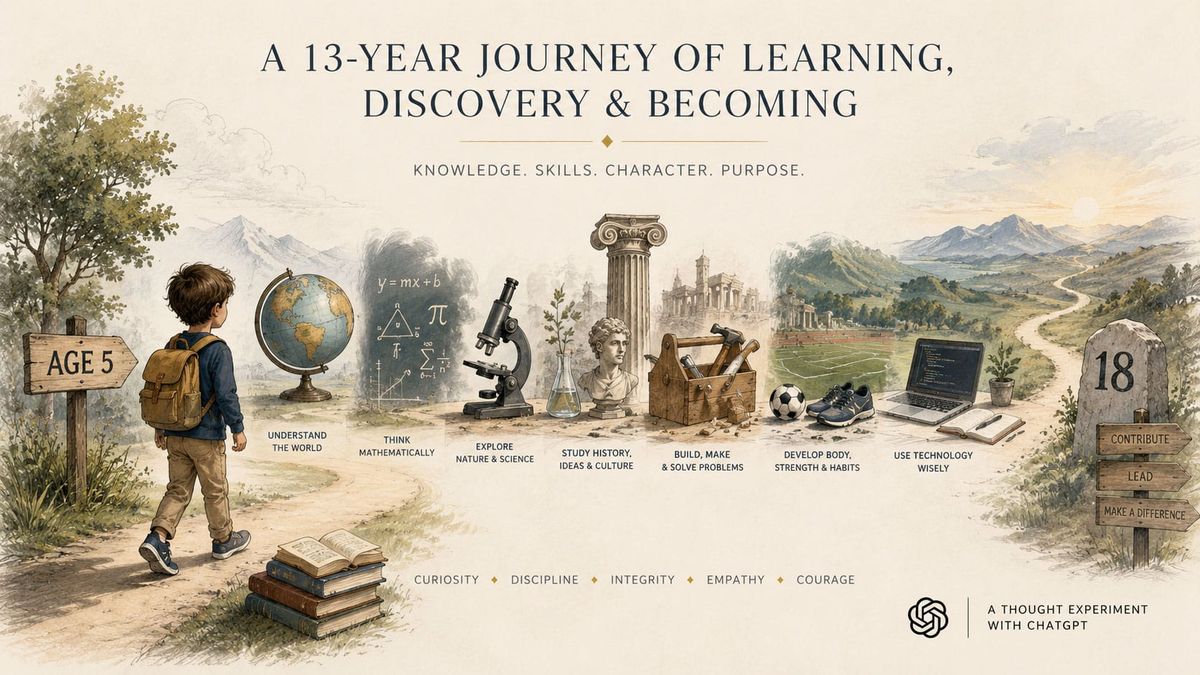
If I had to compress the entire plan into one progression, it would be:
5–7: Learn to read, count, move, observe and wonder.
8–10: Acquire an enormous store of knowledge about the world.
11–13: Learn to reason, argue, calculate, investigate and write.
14–16: Connect disciplines and solve increasingly real problems.
16–18: Do serious intellectual work and increasingly serious adult work.
And throughout all thirteen years:
Read difficult books. Play sports. Make things. Talk with adults. Spend time outside. Learn mathematics. Write constantly. Encounter competing ideas. Accept responsibility.
There is one further principle I would put above almost everything else.
Preserve agency.
By eighteen, the objective would not be to have produced a young person who is extraordinarily good at school. It would be to have produced someone who no longer particularly needs school—someone capable of deciding “I want to understand this” and then possessing the reading ability, mathematical tools, background knowledge, discipline, skepticism and confidence necessary to go learn it.
That, to me, is the point at which an education has succeeded.
Editor's note: This prompt was submitted to OpenAI's ChatGPT (GPT-5.6 Sol) on August 15, 2026. The response is reproduced without editing. The feature image was also generated by ChatGPT.