The action field: a better way to think about athleticism

Athleticism is a commonly used but abstract term, with no universally accepted definition.
As coaches, we exhort our players to improve their athleticism, and their families to support them in doing so. We develop sports-performance programs to help our players become better athletes. Through combines, tryouts, and other evaluations, we test and measure athletes, both to identify their strengths and weaknesses and to help them chart their progress.
Yet we rarely explain what we mean by athleticism. We assume "they know what we mean."
We can all understand forty-yard-dash times and heights of vertical jumps. But neither in isolation tells us how athletic a player is. Each measures one particular manifestation of athletic ability.
We need a different mental model: one that brings athleticism out of the clouds and onto the field or court in readily comprehensible ways.
For ball sports in particular, we propose the action field.
We are indebted to a conversation with sports-performance coach Raphael Ruiz for steering us toward this idea. Coach Ruiz spoke about athletic development as a process of helping the athlete "play in a bigger bubble" — that is, of expanding the space in which he can make a play.
The action field builds on Coach Ruiz's spatial metaphor by explicitly adding time and effectiveness.
An action field is the three-dimensional space in which an athlete can perform an effective action within a given interval of time.
Consider some examples.
In a fixed-distance race, what separates contestants is the time they require to cover the distance. Athletic training cannot alter the distance of the race. It can, however, reduce the time necessary to cover it.
Ball sports present the same relationship between space and time in a different way. Instead of asking how quickly an athlete can cover a fixed distance, we can ask how much space an athlete can cover within a fixed amount of time.
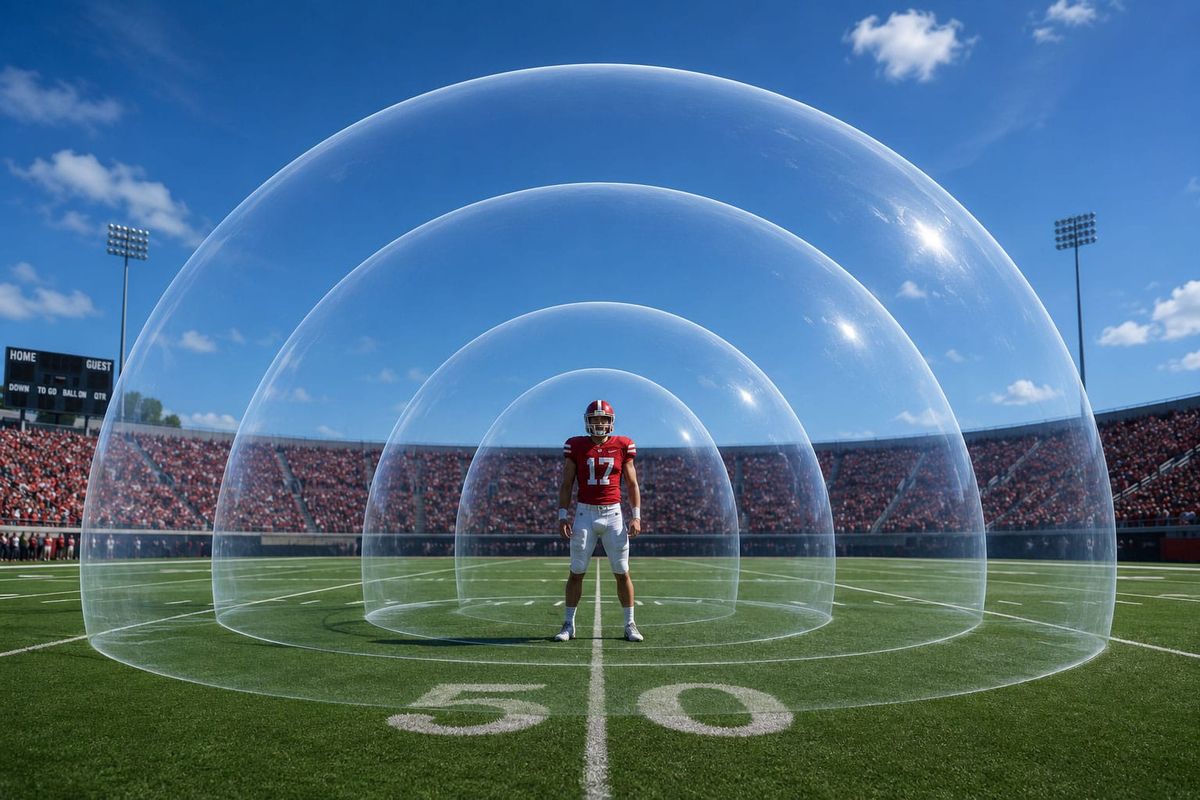
The concentric hemispheres surrounding the football player in our feature image illustrate this idea in idealized form. Each represents the space within which the athlete can act within a particular interval of time. A faster, more explosive athlete can, other things being equal, play in a bigger bubble.
The video below, from an August 2026 football practice at the University of Texas, provides a striking example. Texas wide receiver Cam Coleman makes a spectacular one-handed catch against his direction of motion, in the air, while moving laterally across the field. The familiar football expression catch radius describes one type of action field.
The catch radius is insane
— Texas Football (@TexasFootball) August 8, 2026
Cam Coleman 🤯 pic.twitter.com/yyKGbWetBP
To understand the action field more precisely, begin by eliminating movement.
Take two athletes of comparable ability but different sizes. Suppose one is 5'8" and the other 6'5". Assuming normal limb lengths, the taller athlete has a greater reach from a fixed position. If the two are equally capable of catching a football, the taller athlete can act effectively upon balls beyond the shorter athlete's reach.
Now allow them to move.
Provide each athlete with the same stimulus — say, a hard serve toward the back-left corner of a tennis court. Height and limb length still matter, but a much broader set of variables now determines whether and when each athlete can intersect the ball: perception time, reaction time, acceleration, deceleration, speed, and racket speed among them. The shorter athlete may well prevail.
Now allow movement in every direction.
From a given starting position, an infinite array of vectors describes the athlete's possible paths through the horizontal plane. But no athlete can move equally well along every vector. He may be faster to his left than to his right and will almost certainly move faster forward than backward.
Now add vertical movement and the possibilities multiply. The athlete may need to jump straight up, forward, backward, laterally, or at any of an infinite number of angles to the horizontal plane.
His effective range therefore cannot be described accurately by a hemisphere with a uniform radius.
Consider two shortstops standing in the same place. Hit a ball at the same velocity ten feet to their left. Both field it.
Hit another eleven feet to their left. Both field it.
Hit another twelve feet to their left. Both field it.
Continue the drill, always hitting the ball at the same velocity.
Eventually you will reach a distance at which only one player can field the ball. For that particular task and interval of time, that player's action field extends farther in that direction.
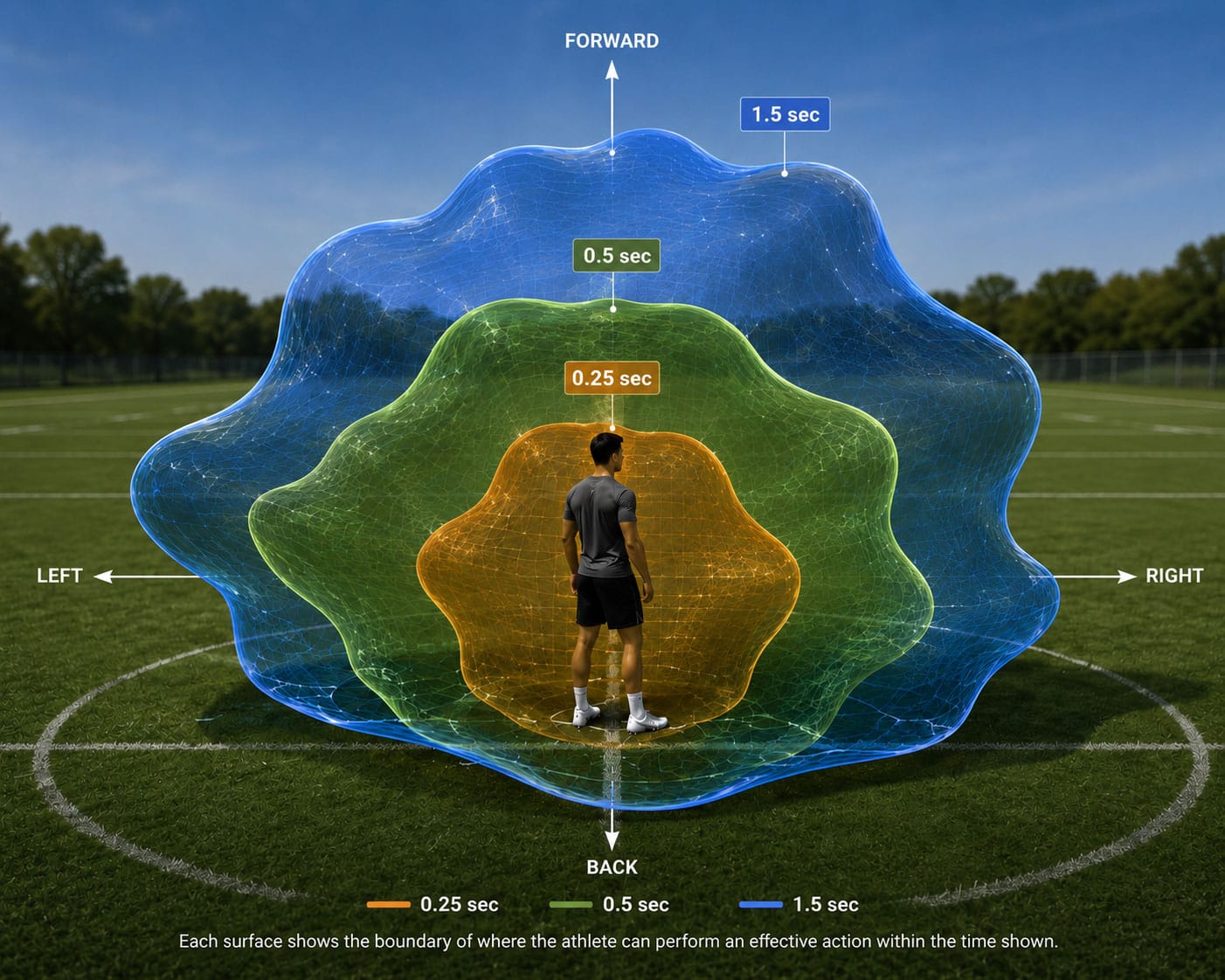
And in reality, the boundary of an athlete's action field will not be smooth. It will form an irregular three-dimensional shape because the athlete cannot move equally well along every possible path.
Now introduce time explicitly.
Where can the athlete act effectively in 0.25 seconds? Half a second? A second? Three seconds?
Each interval defines a different action field. Our nested irregular fields represent these time-bounded limits. As an athlete becomes quicker and faster, those boundaries can move outward.
But the relationship between athleticism and time works in another direction as well.
Suppose two shortstops can both field the same ground ball. One reaches it in 1.2 seconds and the other in 1.5. The first player has not merely reached the ball faster. He has created three-tenths of a second of usable time.
That time can be spent decelerating, getting his body under control, transferring the ball, setting his feet, or making the throw.
The same principle applies elsewhere. A basketball defender who arrives sooner may establish defensive position rather than collide with the ball handler. A tennis player who reaches the ball sooner may prepare and make a controlled return rather than merely get a racket on it.
Athleticism does not literally create time. It allows the athlete to complete necessary movement sooner, leaving more time available for whatever must happen next.
This brings us to the final component of the action field: effectiveness.
It is not enough merely to reach a point in space.
When the basketball defender reaches the dribbler, does he crash into him, or can he arrive in a solid defensive position? Can the shortstop merely knock down the line drive, or can he lay out and make the catch? If the tennis player can reach the serve with his racket, can he return it?
The boundary of the action field therefore lies not at the limit of where the athlete can reach, but at the limit of where he can act effectively within the available time.
Our model consequently has three essential components:
space, time, and effectiveness.
This gives athletes a more concrete way to think about athletic development.
Training can expand the space in which an athlete can make a play. It can reduce the time required to make a play. And it can improve what the athlete is capable of doing when he gets there.
The irregular shape of an action field can also help us think about athletic weaknesses. A comparatively short portion of the field may reveal a direction or movement in which the athlete is limited. Not every asymmetry is a deficiency — human beings are not designed to move equally well in every direction — but some limitations can be identified and improved through training.
For a baseball player, this matters because baseball itself may not provide enough repetitions of the movements necessary to enlarge every relevant part of his action field. The same is true, in different ways, of every sport.
Sports-performance training, free play, and participation in other sports expose young athletes to movements and physical problems that their primary sport may seldom provide. Some of those experiences can expand the athlete's action field.
Others develop athletic abilities that the action-field model does not capture at all.
That is the subject of our next post.
Credits: This post was developed with assistance from OpenAI’s ChatGPT, which served as a sounding board and editorial collaborator in developing and refining the action-field concept and reviewing successive drafts. ChatGPT also created the feature image and the illustration of the irregular, time-bounded action fields. The original “bigger bubble” metaphor that inspired the action-field concept is credited above to sports-performance coach Raphael Ruiz.